The objection that stops most first beverage import orders is not price and it is not lead time. It is volume concentration: a 20ft container filled with a single reference means roughly 58,000 cans of one product, bought before a single case has been sold in the destination market. A mixed container removes that constraint. It is one full-container load, one commercial invoice and one customs entry, carrying several categories and several SKUs from the same supplier.
COPROVE Trading has exported beverages, food and tobacco from Valencia since 2012, with a production capacity of 14 million cans per month and 1.6 million hectolitres, across 83 active products in 9 categories and more than 12 own brands. Mixed containers are standard operation, not an exception granted to large accounts. This guide covers what fits in a mixed load, how importers in the US and UK typically split a first container, what it changes at customs, and what it does not change.
What is a mixed container in beverage importing?
A mixed container is one full-container load combining several categories and SKUs from a single supplier, under one invoice and one customs entry.
The term is often confused with two different things, and the distinction matters commercially:
- Mixed container (FCL). The importer books the whole container and decides what goes inside it. The load is consolidated at the exporter’s facility. One shipper, one consignee, one Bill of Lading, one document set. This is what COPROVE ships.
- Groupage or LCL. The importer buys part of a container and shares the box with unrelated cargo from other shippers. Cheaper on paper, but it adds a consolidation warehouse, a deconsolidation warehouse, extra handling fees and a longer, less predictable transit.
- Mixed pallets. A pallet-level concept, not a container-level one: several SKUs stacked on one pallet. Useful for samples and small assortments, but it does not change the size of the commitment the importer is making.
A mixed FCL keeps the freight economics of a full container while removing the assortment risk. The importer pays for one box and fills it with the product mix the destination market actually needs.
Why do first-time importers avoid committing to a full container of one SKU?
Because a 20ft container of one SKU means about 58,000 cans of untested demand. A mixed load spreads that risk across several categories.
The arithmetic behind the hesitation is straightforward. A single-SKU 20ft container of 33 cl cans is 58,032 units. If the importer’s forecast is wrong by 30%, that is roughly 17,000 cans sitting in a warehouse against a shelf-life clock. The financial exposure is not the freight, it is the working capital locked in one bet.
Four specific risks concentrate in a single-SKU first order:
- Flavour and format preference is local. Which soft drink flavours and which can size move fastest varies market by market. No supplier can predict it for a market they do not sell in.
- Channel fit is unknown until the product is placed. A reference that performs in convenience retail may not perform in wholesale cash-and-carry, and the importer usually only discovers this after the first placements.
- Shelf life sets a hard deadline. Beer carries 18 months, soft drinks 15 months and juices 12 months from production. Slow rotation on a concentrated load turns into markdowns.
- Category margins differ. Soft drinks, beer and energy drinks deliver the best distributor margin in COPROVE’s catalogue. An importer who commits everything to a lower-margin category loses the chance to fund the operation with the stronger ones.
A mixed container converts the first order from a forecast into a measurement. The importer sells through, records the rotation per category, and the second order is built on data instead of assumptions.
What is the minimum order for a mixed container from Spain?
COPROVE’s minimum order is one 20ft container, FCL. That container can be mixed across all 9 categories and any of the 83 active products.
There is no separate, higher minimum for mixed loads and no surcharge for splitting the container across categories. The constraints that do apply are physical and commercial rather than contractual:
- Full pallets per SKU. The load is built in complete pallets, so each reference in the mix is ordered in pallet multiples rather than individual cases.
- Weight before volume. Canned and bottled beverages are dense cargo. A 20ft container reaches its weight ceiling before it runs out of space, which is why the unit counts below are lower than a purely volumetric calculation would suggest.
- Alcoholic and non-alcoholic in the same box. Technically straightforward from the exporter’s side, but the importer’s licensing and excise position in the destination country determines whether it is advisable. In the US, beer and spirits require a TTB Importer’s Basic Permit that non-alcoholic categories do not.
Free product samples are available before any order is placed, with the buyer covering shipping. Samples are the cheapest way to validate flavour profiles and packaging before a container is committed.
How many units fit in a 20ft or 40ft container of beverages?
A 20ft container loads 58,032 cans of 33 cl or 37,752 cans of 50 cl. A 40ft loads 67,392 and 44,712 respectively. Mixed loads split those totals.
These are COPROVE’s catalogue loading references for its two highest-volume formats. The 33 cl can is shared by three categories — beer, soft drinks and malt beverages — which is why a three-way split is so easy to calculate.
| Format | Categories using it | Units per 20ft FCL | Units per 40ft FCL |
| Can 33 cl | Beer, soft drinks, malt beverages | 58,032 | 67,392 |
| Can 50 cl | Beer | 37,752 | 44,712 |
Applied to a mixed load in 33 cl cans, the split is proportional:
- 50 / 50 across two categories — approximately 29,000 cans each in a 20ft container.
- Three-way split (for example beer, soft drinks and malt) — approximately 19,300 cans per category in a 20ft container.
- Four-way split — approximately 14,500 cans per category in a 20ft container, or 16,800 in a 40ft.
The remaining formats in the catalogue — 250 ml energy drink cans, 20 cl Tetra Brik juices, 70 cl and 1 L spirit bottles, 1.5 L PET water and 1 L PET sunflower oil — have different weight-to-volume ratios, so their unit counts are confirmed individually in the loading plan issued with the quotation rather than estimated from a generic table. Mixing a heavy format such as PET water with a light one such as 250 ml cans changes the total unit count of the container significantly, and getting that calculation right before booking is what keeps a container from being weight-rejected at the destination port.
Which product categories can be combined in one container?
All nine: beer, soft drinks, energy drinks, malt, juices, spirits, water, sunflower oil and tobacco — 83 products across more than 12 own brands.
Every category below is produced or sourced under COPROVE’s own brands, which is the structural reason a single container can span all nine. An importer buying from a distributor of third-party brands has to consolidate across several suppliers, several invoices and several lead times. Here it is one purchase order.
| Category | SKUs | Format | Role in a mixed container |
| Beer | 19 | Can 33 cl and 50 cl | Volume anchor — highest export category and 18-month shelf life |
| Soft drinks | 28 | Can 33 cl | Widest assortment and strongest distributor margin |
| Energy drinks | 6 + 1 vodka energy | Can 250 ml | High rotation, light format, fast repeat purchase |
| Malt beverages | 6 | Can 33 cl | Non-alcoholic, strong in West African and Caribbean channels |
| Juices | 8 | Tetra Brik 20 cl | Ambient, dense stacking, family and school channels |
| Spirits | 9 | Bottle 70 cl and 1 L | Highest value per pallet, glass weight is the constraint |
| Water | 3 | PET 1.5 L | Heavy filler, use sparingly in a mixed load |
| Sunflower oil | 1 | PET 1 L | Food-category entry point alongside beverages |
| Tobacco | 2 | Pack of 20 | Light, high value density, separate excise regime |
All brands are COPROVE’s own. For the importer this means the container does not arrive carrying products that the same market can already buy from three other distributors, and there is no brand owner setting the retail price above the importer’s head.
How should a first-time importer split a mixed container?
Weight the load toward beer, soft drinks and energy drinks — COPROVE’s highest-volume export categories and the best margin for distributors.
There is no universal split, because the right mix depends on the importer’s channel and market. But the pattern that repeats across COPROVE’s export operations is consistent enough to be a starting point:
- Core of the load: beer and soft drinks. These are the two largest export categories by volume and both use the 33 cl can, which simplifies the loading plan. Soft drinks also carry the strongest distributor margin, and with 28 SKUs the flavour range is wide enough to test several profiles inside one order.
- Growth slot: energy drinks. The 250 ml can is the lightest unit in the catalogue, so energy drinks add SKU variety without consuming much of the container’s weight allowance. Rotation is typically faster than any other category.
- Market-specific slot: malt or juices. Malt beverages perform strongly in West African and Caribbean channels; juices in family and institutional retail. One or two pallets is enough to read the response.
- Test slot: spirits, water, oil or tobacco. Small allocations that open a new category with the customer base the importer already has, without a dedicated shipment.
Two practical rules apply regardless of the mix. Keep heavy formats such as 1.5 L PET water to a minority of the load, since they consume weight allowance that lighter, higher-margin cans could use. And keep the number of SKUs in a first container manageable — a mixed container is a measurement instrument, and a load split across forty references produces sell-through data too thin to act on.
What does shipping a mixed container from Spain involve?
Departure from Valencia or Barcelona under FCA, FOB or CIF, with production and preparation of 4 weeks from order confirmation.
Mixing categories does not change the shipping mechanics. The container is loaded at COPROVE’s facility, less than two hours from the port of Valencia, and moves as a single FCL booking.
- Incoterms. FCA, FOB or CIF. On CIF shipments COPROVE books through its own freight forwarders and transport insurance is available. EXW is not offered.
- Ports of departure. Valencia and Barcelona, both with regular direct services to US East and Gulf Coast ports and to UK and North European hubs.
- Lead time. 4 weeks from order confirmation to container loaded, mixed or single-category. Ocean transit is additional and depends on the destination port.
- Payment. Bank transfer (T/T), Letter of Credit (L/C) or cryptocurrency. Payment is settled before shipment.
- Quotation. Maximum 24 hours from receipt of the requirement, including the loading plan for the requested mix.
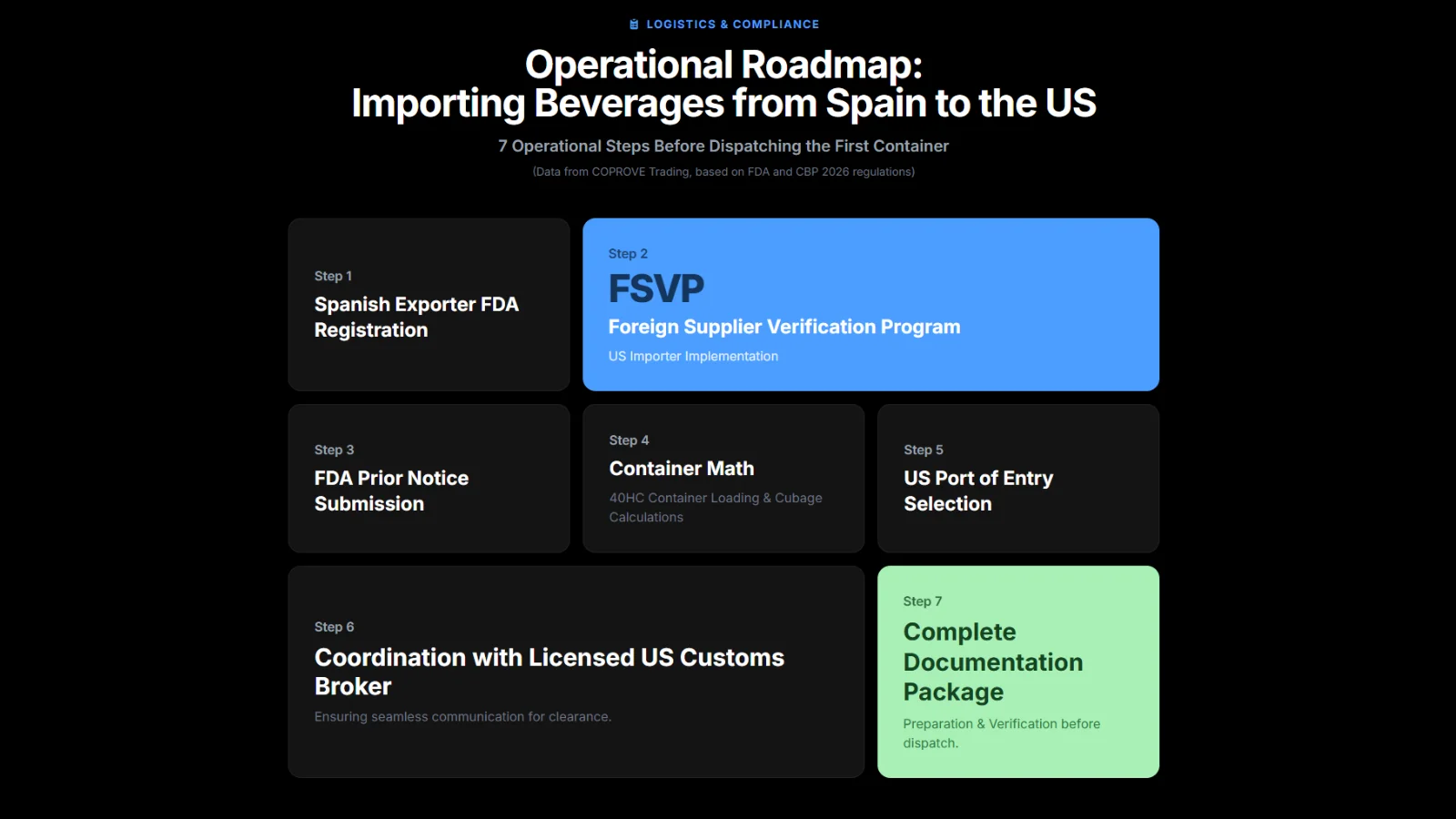
Importers shipping to the United States should read the operational sequence for that corridor separately — FDA facility registration, FSVP verification and Prior Notice apply to a mixed container exactly as they apply to a single-category one. The full sequence is covered in the guide to importing beverages from Spain to the USA.
Does a mixed container complicate customs and certification?
No. A mixed container clears as one shipment with one document set. BRC and IFS certification covers every category in the load.
This is the point most first-time importers get wrong. They assume nine categories means nine sets of paperwork. In practice a mixed FCL is a single entry with multiple line items:
- One document set. Commercial invoice, packing list, certificate of origin, Bill of Lading and health certificates cover the whole container. Each SKU appears as a line item, not as a separate shipment.
- Multiple tariff codes, one entry. The customs broker classifies each category under its own HS code within the same entry. Beer, spirits and tobacco carry excise duties that soft drinks, juices and water do not, so the broker should see the loading plan before the container sails.
- BRC and IFS across the catalogue. Both certifications are held at production level, which means the food safety evidence an importer needs is the same whether the container carries one category or nine. For US importers this is what makes FSVP supplier verification a documentation exercise rather than an audit programme.
- REX registered exporter. Statements of origin are issued under the EU registered exporter system. EUR1 forms and certificates of origin are issued on request through the Chamber of Commerce.
- Health and sanitary certificates. Issued by the Spanish authorities, not by a private laboratory, and covering the categories present in the load.
- Halal and Kosher. Obtained on request for the specific products and destination that require them, rather than held as standing certificates.
Labelling is the one area where the category mix does matter. Labels are already adapted for the US market; other destinations may require relabelling by the importer to meet local declaration rules. From orders of five containers upward, COPROVE customises labels with the importer named as distributor and the country-specific requirements applied at production.
Can an importer secure an exclusive brand for their market?
Yes. COPROVE assigns a brand exclusively to one importer per market, so the buyer builds equity in a name no local competitor can source.
This is not private label — COPROVE does not manufacture under third-party brands. The model is different and, for an importer, better: COPROVE owns a portfolio of more than 12 brands, and a brand can be allocated to a single importer within a defined territory. In one market COPROVE currently operates four of its brands, each assigned exclusively to a different importer, with no overlap between them.
The commercial consequences for the importer are concrete:
- No grey imports of the same label. A competing distributor in the same country cannot buy the same brand from the same source and undercut the price.
- No competition against global brands at distributor level. The importer is not reselling a product whose price is already benchmarked in every retailer in the country.
- No tooling, minimum design run or brand development cost. Unlike private label, the brand already exists, is already produced and is already certified. The importer starts selling with the first container.
- The mixed container becomes the launch vehicle. An exclusive brand can span several categories in one shipment, so a market launch covers beer, soft drinks and energy drinks under one name from day one.
How does an importer order a mixed container from COPROVE?
Send target categories, destination port and Incoterm by WhatsApp or email. COPROVE returns a loading plan and quote within 24 hours.
The sequence for a first mixed container:
- The importer sends the target categories and approximate split, container size (20ft or 40ft), destination port and preferred Incoterm — FCA Valencia, FOB Valencia or CIF destination.
- COPROVE replies within 24 hours with per-SKU pricing, a loading plan showing exact unit counts per format, total weight and the documentation package the importer’s customs broker will receive.
- Free samples are shipped on request so flavour profiles and packaging can be validated before the order is confirmed. The buyer covers sample shipping.
- The importer reviews tariff classification and excise exposure per category with the customs broker, using the loading plan as the reference document.
- Order confirmed and payment agreed: bank transfer (T/T), Letter of Credit (L/C) or cryptocurrency.
- Production and preparation: 4 weeks to container loaded at Valencia or Barcelona. Documentation issued, Bill of Lading released, container sails.
After the first container, the second order is built from sell-through data rather than forecasts: the categories that rotated fastest take a larger share, the ones that did not are dropped or reduced. That is the entire point of shipping mixed.
Request a mixed container loading plan in 24 hours
COPROVE Trading has exported from Valencia without interruption since 2012, shipping to more than 20 countries with a capacity of 14 million cans per month and 1.6 million hectolitres. The catalogue covers 83 active products across 9 categories — beer, soft drinks, energy drinks, malt beverages, juices, spirits, water, sunflower oil and tobacco — all under own brands from BRC- and IFS-certified production. Send the categories to test and the destination port, and COPROVE returns a loading plan with exact unit counts and pricing within 24 hours. No commitment required. Free product samples available — buyer covers shipping.
Note on figures: container unit counts are COPROVE catalogue loading references for standard 20ft and 40ft equipment. Exact counts for a specific mix are confirmed in the loading plan issued with each quotation, since weight limits vary by format and by destination road-haulage regulation. Tariff classification, excise treatment and labelling requirements should be verified with a licensed customs broker in the destination country before booking.