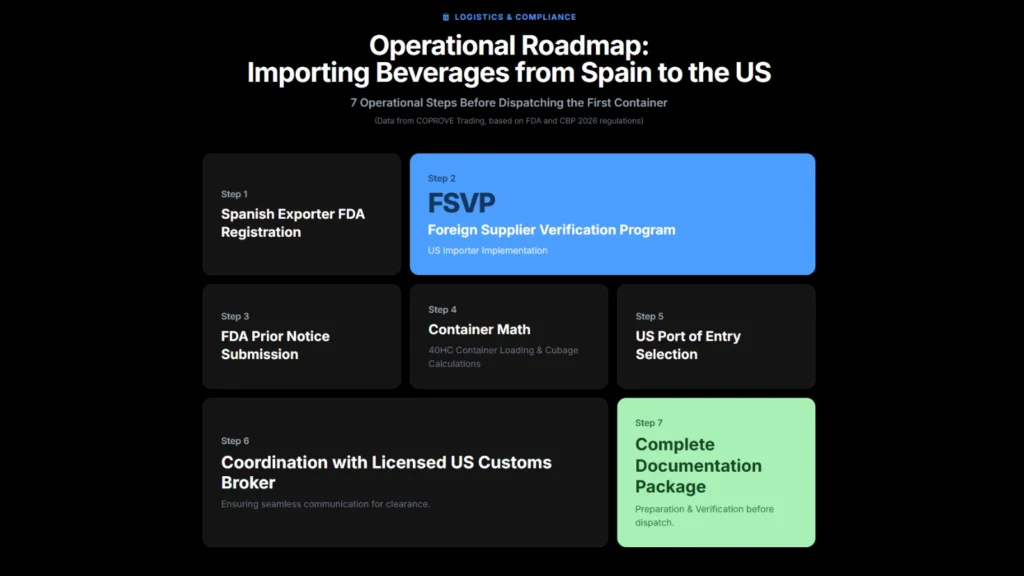
A US importer ready to bring beverages from Spain faces seven concrete operational steps before the first container clears a US port. The order matters, the timing matters, and the documentation matters more than most first-time buyers expect. This guide walks through the full execution playbook used by wholesale buyers and distributors importing beer, soft drinks, energy drinks, malt beverages, juices and water from Spanish exporters under FDA jurisdiction.
The data and timings come from COPROVE Trading’s real export operations to US-bound markets, combined with the FDA and US Customs and Border Protection (CBP) regulatory framework current as of 2026. COPROVE has shipped beverages to over 20 countries for 14 years from Valencia, with BRC, IFS and REX certifications. The objective of this guide is operational, not promotional: give a US wholesale buyer everything needed to plan the first import correctly.
Why do US wholesale buyers source beverages from Spain?
US buyers source from Spain for own-brand portfolios, Mediterranean transit access, BRC/IFS-certified production and FCL pricing that competes with northern European hubs.
Three concrete reasons drive the sourcing decision from the US side:
- Private-label catalog without competing global brands. Spanish exporters like COPROVE produce own-brand beer, soft drinks and energy drinks, which means the US importer does not compete in-market against Red Bull, Monster or Coca-Cola at distributor level. The importer defines pricing and shelf positioning.
- Mediterranean ports with direct US East and Gulf Coast service. Valencia and Barcelona run weekly direct services to Miami, Houston, New York/New Jersey, Savannah and Charleston. Transit times from Valencia to the US East Coast are competitive with northern European departures.
- BRC and IFS certifications recognized by FSVP-compliant US importers. The Foreign Supplier Verification Program (FSVP) requires the US importer to verify the foreign supplier’s hazard controls. A BRC- or IFS-certified facility makes that verification straightforward and cost-effective.
Step 1 — How does a Spanish beverage exporter register with the FDA?
The Spanish exporter must hold a current FDA Food Facility Registration, renewed every even-numbered year between October 1 and December 31, before any US-bound shipment leaves port.
Under the Bioterrorism Act of 2002 and FSMA, any foreign facility that manufactures, processes, packs or holds food for human consumption in the US must register with the FDA. The facility receives an FDA Food Facility Registration Number. Key points the US importer should verify with the Spanish supplier before placing the first order:
- Active registration number. The number must be current and reflect the actual production facility, not a corporate trading address.
- Biennial renewal. Registration must be renewed every even-numbered year between October 1 and December 31. Shipments after January 1 of the following odd year without renewal are detained at the US port.
- US Agent designation. Every foreign-registered facility must name a US Agent — a person or entity physically located in the United States who serves as the FDA’s point of contact. The US Agent must accept the designation electronically.
- Product categories declared. The categories on the registration must match the actual products shipped (beverages, alcoholic beverages, dietary supplements where applicable). Mismatches trigger FDA holds.
COPROVE Trading operates with current FDA Food Facility Registration for beverage categories and provides the registration number to US importers during the quotation phase, so the buyer’s customs broker can validate it before the booking is confirmed.
Step 2 — What does the FSVP require from a US importer buying from Spain?
The FSVP requires the US importer to conduct hazard analysis, verify the foreign supplier’s controls, keep records for at least two years and identify a Qualified Individual.
The Foreign Supplier Verification Program (FSVP) places the regulatory responsibility for the safety of imported food on the US importer, not on the foreign exporter. The importer of record must execute and document specific verification activities:
- Hazard analysis. The importer identifies biological, chemical and physical hazards that may be associated with each beverage category. For canned beverages, the typical hazards include microbiological contamination, packaging integrity failure and undeclared allergens.
- Foreign supplier evaluation. The importer evaluates the foreign supplier’s performance and the risk posed by the product. Third-party certifications such as BRC and IFS substantially simplify this evaluation because they audit the supplier’s hazard controls under recognized GFSI schemes.
- Verification activities. The importer selects appropriate verification: on-site audits (annual for high-risk products), sampling and testing, or review of the supplier’s food safety records. BRC- and IFS-certified suppliers typically reduce on-site audit burden because the auditing is performed by accredited third parties.
- Qualified Individual (QI). The FSVP activities must be developed, conducted and signed off by a person with the education, training or experience necessary to perform them. The QI is the named accountable person in the importer’s records.
- Recordkeeping. The importer retains FSVP records for a minimum of two years and must produce them upon FDA request. Records include the hazard analysis, supplier evaluation, verification activities and any corrective actions.
COPROVE Trading provides US importers with the documentation required to support their FSVP file: current BRC and IFS certificates, hazard control documentation, batch traceability records and product specification sheets. This shortens the importer’s FSVP setup from weeks to days.
Step 3 — What is FDA Prior Notice and when must it be submitted?
Prior Notice is the electronic submission of shipment data to the FDA before the food arrives in the US, due no later than 8 hours before arrival by sea.
Prior Notice is a per-shipment requirement, distinct from Food Facility Registration (which is per-facility, biennial). The submission tells the FDA what is arriving, when, where and from whom. Missing or late Prior Notice causes the shipment to be refused admission at the US port.
- Submitter. Filed electronically via the FDA Prior Notice System Interface (PNSI) or through the customs broker’s Automated Broker Interface (ABI). Most US importers route Prior Notice through their customs broker for accuracy.
- Timing. For ocean freight, no less than 8 hours before arrival at the US port. For air, no less than 4 hours before arrival. For truck, no less than 2 hours before arrival. For rail, no less than 4 hours. Ocean freight from Valencia gives more than enough lead time, but the documentation must be ready at booking. (Source: 21 CFR Part 1, Subpart I.)
- Required data. Submitter and transmitter identification, FDA Food Facility Registration number of the manufacturer, product code, quantity, country of production, shipper, consignee, mode of transport, port of arrival, anticipated arrival date and time.
- Confirmation number. The FDA returns a Prior Notice Confirmation Number that must accompany the shipment. The carrier verifies the number is present and active before unloading at the US port.
COPROVE supplies the manufacturer’s FDA registration number, product codes and full commercial documentation at booking, so the US importer’s customs broker can prepare Prior Notice with the actual vessel ETA — not estimates that need correction at the last moment.
Step 4 — How many cans or bottles fit in a 40HC container from Spain?
A 40HC high-cube container loads approximately 70,000-78,000 cans of 33cl on EUR pallets, or 50,000-58,000 cans of 50cl, depending on pallet configuration and weight limits.
Container math is decisive for the US importer’s landed cost calculation. Underloading a container wastes ocean freight; overloading triggers weight rejections at the US port. The reference figures below assume EUR pallets (120 x 80 cm) with standard beverage stacking and a 24-ton net weight ceiling typical for US road haulage post-discharge:
| Format | Approx. units per 40HC | Approx. pallets | Notes |
| Can 33cl (beer, soft drinks, malt) | 70,000-78,000 | 24-26 EUR pallets | Standard layer pattern, weight-limited before volume-limited |
| Can 50cl (beer) | 50,000-58,000 | 24-26 EUR pallets | Heavier per unit, weight ceiling reached earlier |
| Can 250ml (energy drinks) | 90,000-100,000 | 24-26 EUR pallets | Lighter format, often volume-limited rather than weight-limited |
| Bottle PET 1.5L (water) | 13,000-15,000 | 24-26 EUR pallets | Heavy and bulky, weight ceiling decisive |
| Bottle 70cl (spirits) | 11,000-13,000 | 24-26 EUR pallets | Glass weight is the constraint |
| Tetra Brik 20cl (juices) | 40,000-48,000 | 24-26 EUR pallets | Stackable, dense load |
USDA does not require ISPM-15 heat treatment for EUR pallets if the wood is certified, but the US importer should confirm with the customs broker that the pallet stamps are visible and legible. COPROVE ships ISPM-15-compliant pallets for all US-bound containers.
Step 5 — Which US port should an importer choose for beverages from Valencia?
New York/New Jersey, Miami and Houston offer the shortest transit times from Valencia. Los Angeles and Long Beach add transit via the Panama Canal but serve the US West Coast directly.
The choice of US port of entry directly affects landed cost, inland freight, FDA office of jurisdiction and customs broker selection. Approximate transit times from Valencia, based on COPROVE’s regular shipping lanes in 2026:
| US port | Transit from Valencia | Best for | Route notes |
| New York / New Jersey | 14-16 days | Northeast distribution, NY/NJ/PA/CT/MA markets | Direct transatlantic, fastest East Coast option |
| Miami | 16-18 days | Florida, Caribbean diaspora markets, gateway to LATAM redistribution | Direct transatlantic, strong frequency |
| Savannah / Charleston | 15-17 days | Southeast distribution, Georgia/Carolinas/Tennessee | Direct transatlantic |
| Houston | 21-24 days | Texas, Mexico border markets, Gulf Coast | Transatlantic with Gulf entry |
| Los Angeles / Long Beach | 26-30 days | West Coast, California distribution, Asian re-export | Routed via Panama Canal |
The transit times are commercial averages from Valencia. Real arrival depends on the steamship line, transshipment hubs and seasonal congestion. Importers planning their first US shipment typically pick the closest port to the final warehouse to reduce inland trucking and demurrage exposure.
Step 6 — Does a US importer need a customs broker for beverages from Spain?
Yes. A licensed US customs broker handles CBP entry filing, duty calculation, FDA Prior Notice coordination and the Importer Security Filing for any beverage shipment from Spain.
US Customs and Border Protection allows an importer of record to self-file entries, but in practice no first-time beverage importer does so. The customs broker is the operational hub that links the foreign exporter, the steamship line, the FDA and CBP. Core broker responsibilities:
- Importer Security Filing (ISF / “10+2”). Submitted no later than 24 hours before the cargo is loaded onto the vessel at Valencia. Ten data elements from the importer, two from the carrier. CBP enforces ISF compliance through liquidated damages of $5,000 per violation, with a maximum of $10,000 per filing for multiple violations of the same ISF.
- CBP entry filing. The broker files the entry summary (CBP Form 7501) classifying each product under the Harmonized Tariff Schedule (HTS). Beer, wine, spirits, soft drinks, energy drinks and water each carry distinct HTS codes and duty rates.
- Duty calculation. Beer and wine are subject to federal excise tax (FET) in addition to customs duty. Spirits carry FET at a higher rate. Soft drinks, energy drinks, juices and water typically carry low or zero duty but require accurate HTS classification.
- FDA Prior Notice coordination. The broker normally files Prior Notice in parallel with the CBP entry, using the supplier’s FDA Food Facility Registration number provided by the Spanish exporter.
- TTB requirements for alcoholic beverages. For beer, wine and spirits, the importer must hold an Importer’s Basic Permit issued by the Alcohol and Tobacco Tax and Trade Bureau (TTB), and the labels must be approved under a Certificate of Label Approval (COLA) before the goods can be released for sale.
The customs broker is the importer’s contractor, not COPROVE’s. The importer selects, retains and instructs the broker. COPROVE delivers the documentation package the broker needs in the format the broker expects, which keeps entry filing fast.
Step 7 — What documentation accompanies a beverage shipment from Spain to the USA?
The standard document set is Commercial Invoice, Packing List, Bill of Lading, Certificate of Origin, FDA Prior Notice Confirmation, ISF filing copy and TTB COLA for alcoholic beverages.
Document accuracy is the single largest cause of US port delays. The document set COPROVE delivers with every US-bound container:
- Commercial Invoice. Detailed line items per SKU, unit price, total value, Incoterm (FCA, FOB or CIF), country of origin, manufacturer’s FDA registration number.
- Packing List. Carton count, pallet count, net and gross weight per pallet, container number and seal number.
- Bill of Lading (B/L). Issued by the steamship line on departure from Valencia, names the consignee and notify party at the US port.
- Certificate of Origin. Issued by the Spanish Chamber of Commerce. Confirms EU origin for any preferential tariff treatment and for FDA country-of-origin tracking.
- Health/Sanitary Certificate. Issued by Spanish health authorities, attests that the beverages were produced under official sanitary supervision.
- FDA Prior Notice Confirmation. Generated by the broker once Prior Notice is filed and accepted.
- ISF filing copy. Confirms the 10+2 was submitted on time.
- TTB COLA (alcoholic beverages only). Required for any beer, wine or spirits sold in the US. The COLA must match the actual label on the can or bottle exactly.
- BRC and IFS certificates. Provided as part of the FSVP supplier file, not for port clearance, but the importer should hold current copies.
Related US-bound categories from COPROVE: the same documentation package covers shipments of wholesale beer, soft drinks, energy drinks, malt beverages, juices, bottled water, spirits and sunflower oil. Mixed containers consolidate multiple categories under a single import entry.
What common mistakes do first-time US importers make?
The most common errors are expired FDA registration, missing US Agent designation, late Prior Notice, mismatched COLA labels and underestimating TTB approval lead time for alcoholic beverages.
Five execution mistakes cost US importers the most time and money on a first beverage shipment from Spain:
- Assuming the supplier’s FDA registration is current. Registration lapses every two years if not renewed. Verifying the registration number through the FDA Industry Systems portal before booking takes minutes and prevents a port detention that costs thousands.
- Filing Prior Notice with estimated vessel ETA. Prior Notice should match the actual ETA. Brokers who file too early without updating get the shipment flagged.
- COLA mismatch on alcoholic beverages. Any difference between the approved COLA artwork and the actual label on the can — including font, color or net contents formatting — gives TTB grounds to refuse release. The importer must review the production proof against the COLA before the cans are filled.
- Underestimating TTB Importer’s Basic Permit lead time. The TTB permit for a new importer of alcoholic beverages can take 60-90 days. New importers planning their first beer or spirits shipment from Spain should start the permit application before placing the order.
- Underpacking the container. Some first-time importers commit to a single SKU and discover the demand profile after the container arrives. Mixed containers allow the importer to test multiple categories in the first shipment and reorder selectively.
COPROVE Trading flags these issues during the quotation phase. The quote includes the FDA registration number, recommended Incoterm, container loading plan and the documentation package the importer’s broker will receive, so the importer’s first shipment is engineered to clear cleanly.
How does a US importer get a personalized quote from COPROVE?
The importer sends target SKUs, container count, US port and Incoterm preference by WhatsApp or email. COPROVE replies in 48 hours with full pricing, documentation list and lead time.
The quotation process is built for execution clarity, not sales pressure. The standard flow:
- The importer sends target categories and SKUs, estimated container count for year one, US port of entry and Incoterm preference (FCA Valencia, FOB Valencia or CIF US port).
- COPROVE replies within 48 hours with detailed FOB/CIF pricing per SKU, the FDA Food Facility Registration number, recommended container loading plan, lead time confirmation and the full documentation package the customs broker will receive.
- The importer reviews pricing with the customs broker and confirms HTS classification and FET exposure for alcoholic categories.
- Order confirmation and payment terms agreed: bank transfer (T/T), Letter of Credit (L/C) or cryptocurrency.
- Production and preparation: 4 weeks from order confirmation to container loaded at Valencia or Barcelona port.
- Documentation package issued, Bill of Lading released, Prior Notice and ISF coordinated with the importer’s broker, container sails.
Free product samples are available before the first order — the buyer covers shipping.
Request a container quote and documentation pack in 48 hours
COPROVE Trading has exported beverages from Valencia for 14 years to over 20 countries, with uninterrupted operations since 2012. The catalog covers more than 80 active products across 9 categories — beer, soft drinks, energy drinks, malt beverages, juices, water, spirits, sunflower oil and tobacco — all from BRC- and IFS-certified production. COPROVE prepares the full FDA, FSVP and customs documentation package the US importer’s broker needs to clear the container at any US port. Request a personalized quote with container pricing in 48 hours via WhatsApp or email. No commitment required.
Disclaimer: regulatory information and operational guidance in this article reflect the framework in effect at the date of publication and are based on public sources (FDA, US Customs and Border Protection, TTB) and COPROVE Trading’s own export operations. Before starting any import operation, the importer should verify current documentation and requirements with a licensed US customs broker. For alcoholic beverages, also consult the TTB and a qualified attorney.
